Why Do Stocks Rally Without News? An Index-Based Perspective

CCPI > Invest Like billionaires > Why Do Stocks Rally Without News? An Index-Based Perspective

A familiar phenomenon that confuses many investors

In financial markets, investors frequently encounter a puzzling situation:
stock prices rise steadily—sometimes sharply—despite the absence of any notable news.

  • No earnings surprise
  • No prominent positive macroeconomic developments
  • No “hot” narrative dominating the media

The common reactions are familiar:

  • “Is there information I don’t know yet?”
  • “Does someone have access to insider information?”
  • “Should I follow the move or stay out?”

In reality, price appreciation without news is not abnormal.
On the contrary, it is a recurring feature of how markets function.

👉 Most investors miss these rallies not because they lack information, but because they wait for something that rarely arrives: confirmation through news.

“Rising ahead of the news” is not an exception—it is how markets operate

With sufficient market observation, a consistent pattern emerges:
most meaningful advances begin when markets are still relatively quiet.

Markets price expectations, not confirmations.
According to aggregated data from Bloomberg and the Federal Reserve Economic Data (FRED):

Between 2010 and 2023, more than 60% of the S&P 500’s gains occurred in the 4–6 weeks preceding FOMC meetings, rather than after interest rate decisions were officially announced.

After the news becomes public, markets often:

  • trade sideways, or
  • experience short-term pullbacks.

This underscores a key reality:
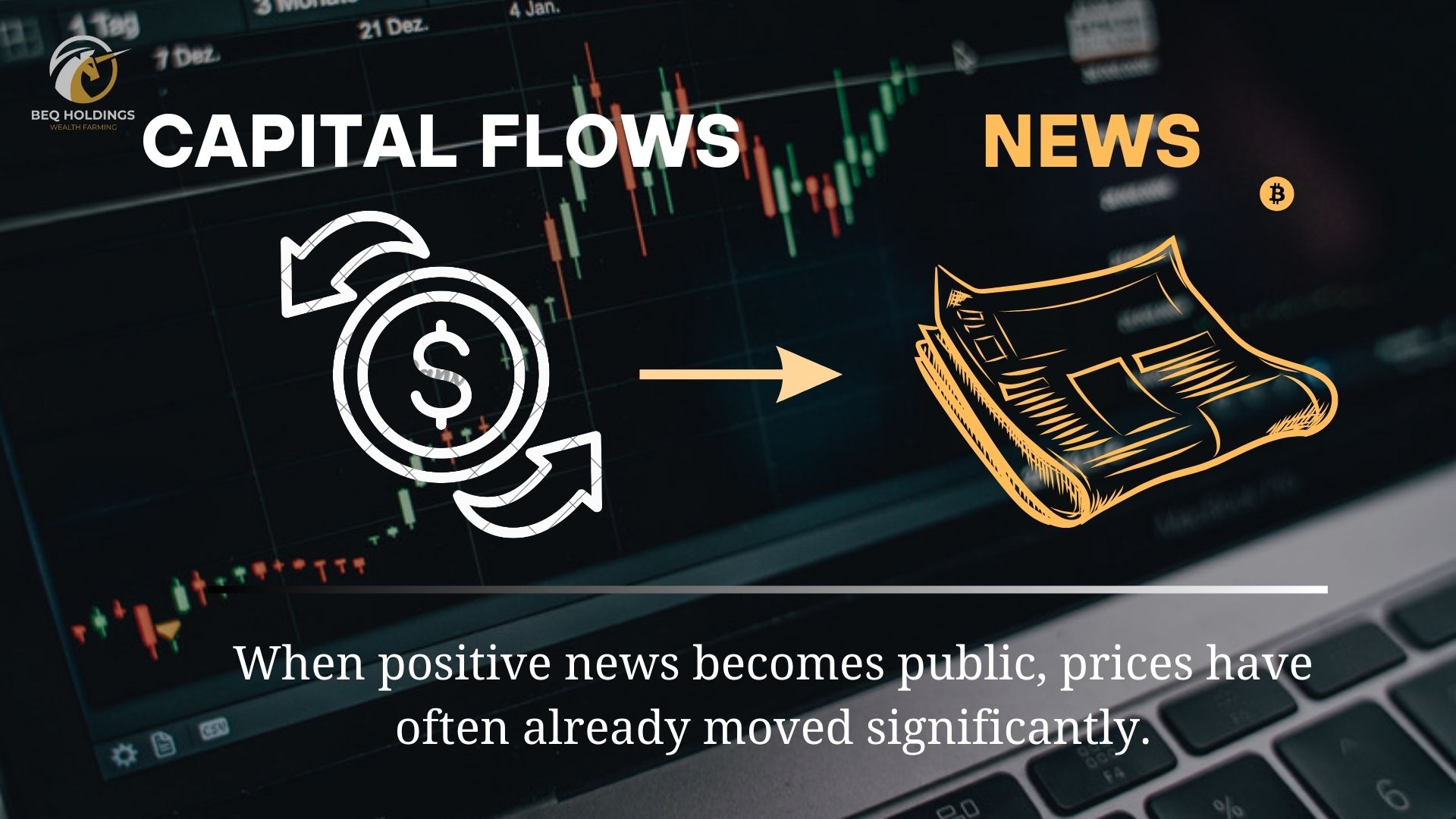
markets do not react to news—they price ahead of it based on expectations and capital flows.
By the time information appears in headlines, much of its impact is already reflected in prices.
Large pools of capital do not need news to act

Institutional investors and large asset managers do not trade based on headlines.
Unlike retail investors, their decisions are driven by:

  • Forward-looking growth expectations
  • Economic and policy cycles
  • Capital allocation rules and risk management frameworks
  • Mandated investment strategies rather than emotion

For these players, news is not a trigger—it is merely confirmation of scenarios already modeled and positioned for.

This explains why:

  • When positive news appears → prices have often already advanced significantly
  • When the outlook becomes “obvious” → risk may actually begin to accumulate

ETF flows: capital that operates independently of news

According to reports from BlackRock and Statista:

  • In 2021, ETF inflows in the U.S. exceeded USD 900 billion, the highest level on record.
  • S&P 500 and Nasdaq-linked ETFs accounted for the largest share of these flows.
  • By the end of 2023, U.S. ETF assets under management surpassed USD 7.5 trillion.

👉 At this scale, asking “What news does this stock have?” becomes far less relevant than asking “Is capital flowing into or out of the Index?”

Key characteristics:

  • ETFs are required to buy the constituents of their underlying indices
  • They do not evaluate whether individual companies have “good news”
  • As long as capital continues to flow into the fund, purchases must be executed

👉 The result:
multiple stocks rise simultaneously—even in the absence of company-specific news.
When prices rise without news, the Index usually signals it first

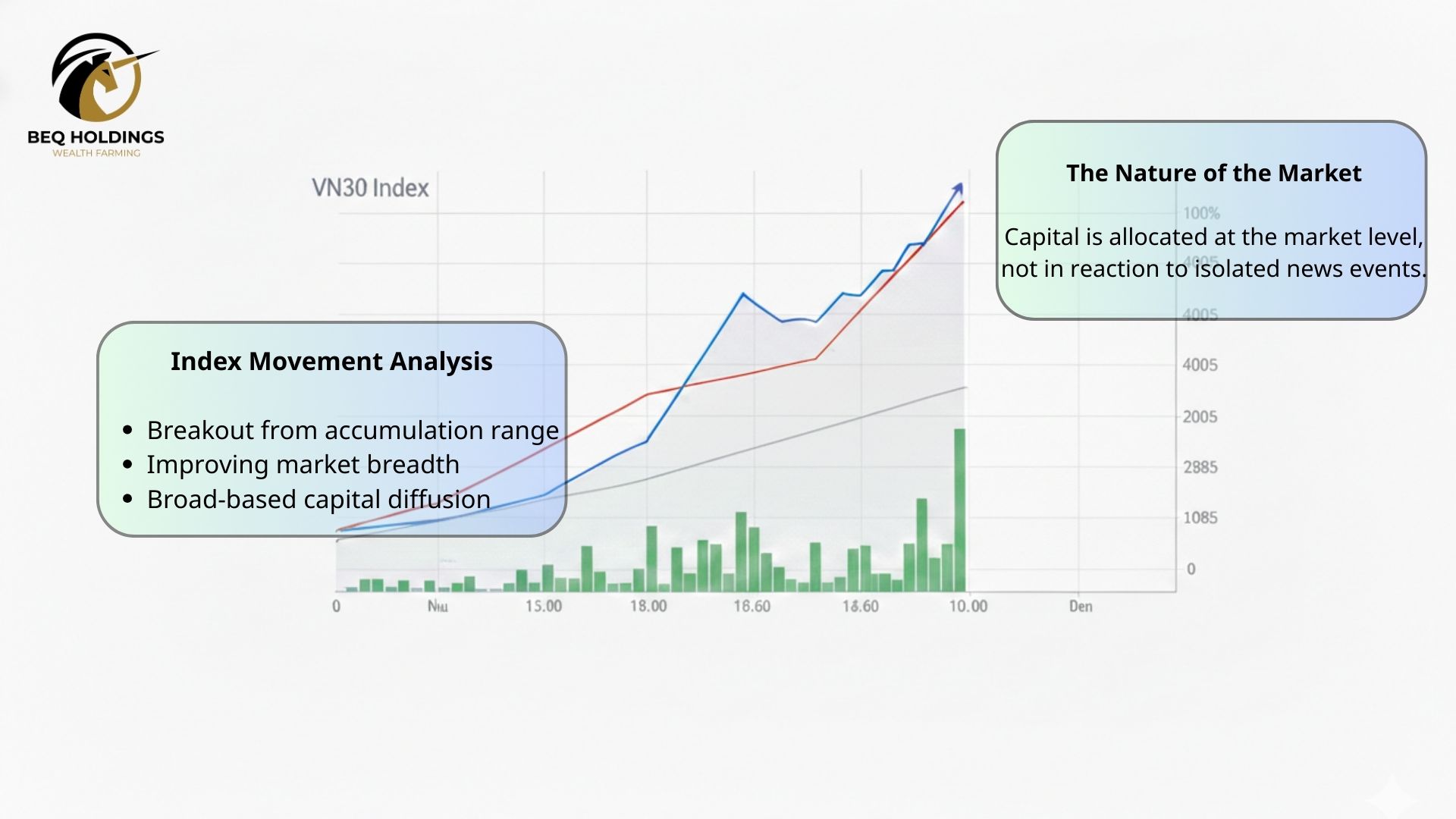
During “newsless” rallies, the most important signals are not found in individual stocks, but in Index-level behavior.

Common observations include:

  • Indices breaking out of consolidation ranges
  • Improving market breadth (advancers outnumber decliners)
  • Capital rotating across sectors rather than concentrating on a single narrative

This reflects a fundamental truth:
capital is being allocated at the market level, not in response to isolated headlines.

These movements typically occur before media coverage intensifies—explaining why investors who wait for news often enter the market late.
(The mechanics of how indices reflect capital flows are analyzed in detail in a separate article on Index dynamics.)
Why do newer investors often distrust these rallies?

Because:

  • There is no news to “validate” the decision
  • No compelling story to anchor expectations
  • No sense of certainty

Experienced investors, however, understand that:

  • Capital does not require media narratives to move
  • Markets often move before they are explained
  • Once everything is clear in the headlines, the edge has largely diminished

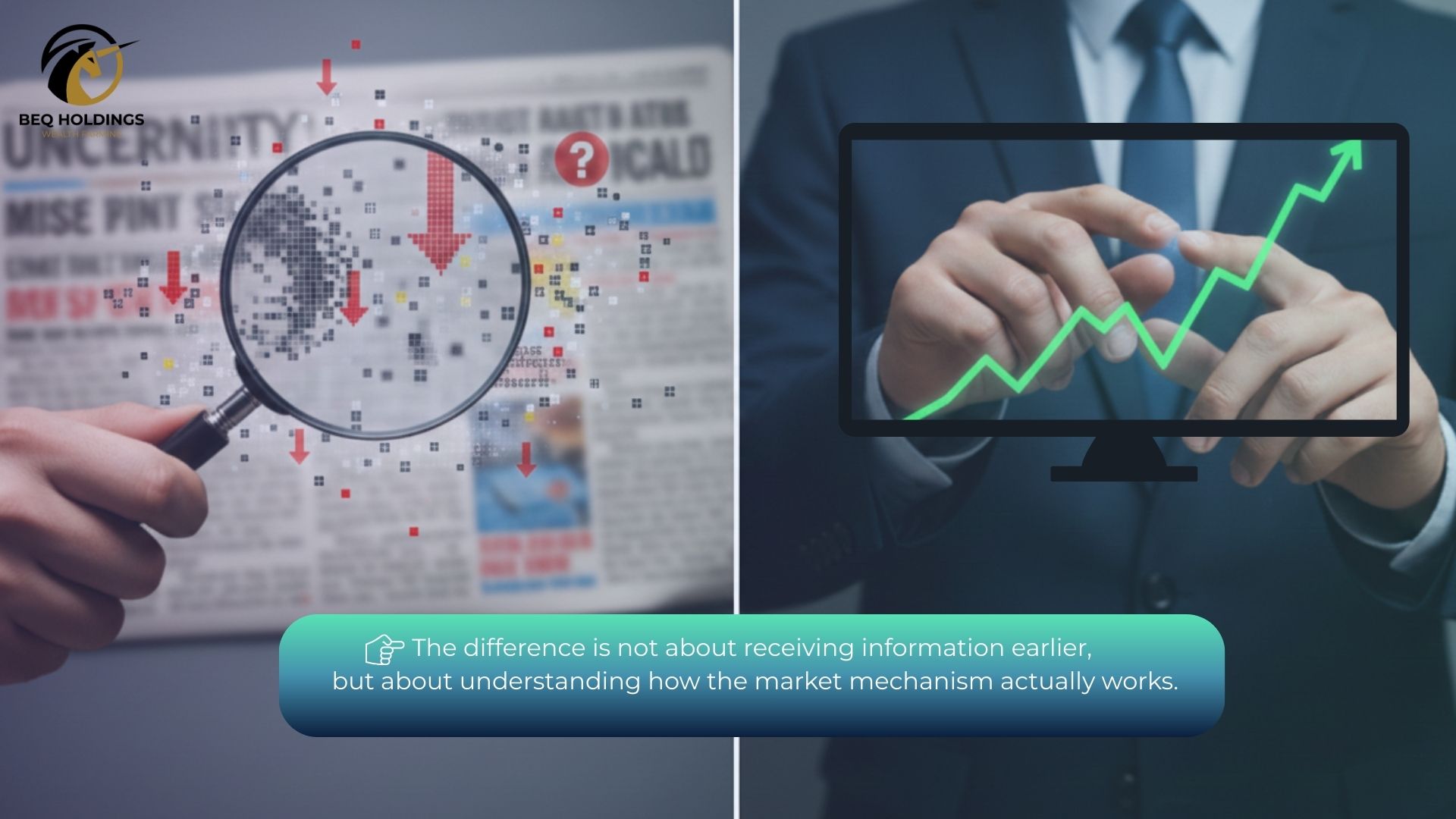
👉 The difference lies not in accessing information earlier, but in understanding how the market allocates capital.

From “price increases without news” to a shift in investment thinking

Once you accept that:

  • Stock prices can rise without news
  • Large capital moves according to plans, not emotions
  • Indices capture these shifts more clearly than individual stocks

Your questions begin to change—from:

  • “Is there any news yet?”

to:

  • At what level is capital being allocated in the market?
  • Is this rally driven by short-term flows or a broader structural trend?
  • Am I moving with capital, or merely reacting to what has already happened?

This marks a shift in investment mindset—from chasing headlines to reading market structure.

BeQ Holdings: tracking capital flows instead of waiting for news

Once it is clear that prices can rise without news, the critical question is no longer “What news is coming?”
but rather: Where is capital moving?

Within the BeQ Holdings ecosystem, each platform serves a distinct purpose:

  • CCPI → Developing an index-based framework for understanding markets and capital structure
  • DashboardLite → Monitoring index movements, market breadth, and the diffusion of capital flows
  • BeQ Indexes → Systematizing these signals into structural indicators to observe markets rather than speculate

No forecasting.
No headline chasing.
Only a single core question:

At what level is capital being allocated—and am I aligned with that flow?

Contact BeQ Holdings for a complimentary consultation
Hotline: +84 941 753 139
Email: contact@beqholdings.com

Our Telegram

Join our Financial Community on Telegram to Receive In-Depth Forecasts and Analyses.

BeQ Unicorn Channel

Link BeQ Unicorn Channel to update the latest financial information daily

Text box item sample content