Short for AutoRegressive Integrated Moving Average, ARIMA is a statistical powerhouse that has stood the test of time, helping analysts and AI systems make sense of the past to predict the future.
Whether it’s forecasting stock prices, energy consumption, or website traffic, ARIMA remains a go-to model for structured, time-dependent data.
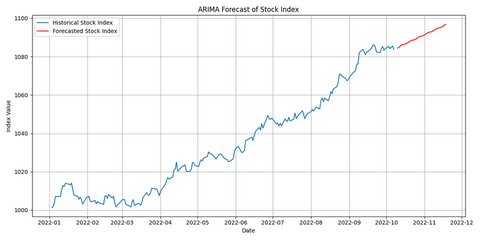
ARIMA is a class of models that explains a given time series based on its own past values, its past errors, and the degree of differencing needed to make the series stationary.
The model is defined by three parameters:
The model is typically denoted as ARIMA(p, d, q):
A stationary time series has constant mean and variance over time. ARIMA assumes stationarity, so if the data isn’t stationary, it must be transformed—usually through differencing. This is where the “I” in ARIMA comes into play.
While ARIMA is not a deep learning model, it is often used in hybrid AI systems. For example, ARIMA might be used to model linear trends, while a neural network captures nonlinear patterns. This combination can yield highly accurate forecasts.
ARIMA is a classic model that continues to thrive in the age of AI. Its strength lies in its simplicity, interpretability, and effectiveness for many real-world forecasting tasks. While deep learning models may dominate headlines, ARIMA remains a trusted tool in the data scientist’s arsenal—especially when transparency and statistical rigor are required.
Would you like a visual walkthrough of how ARIMA forecasts look on sample data, or a comparison with LSTM predictions?