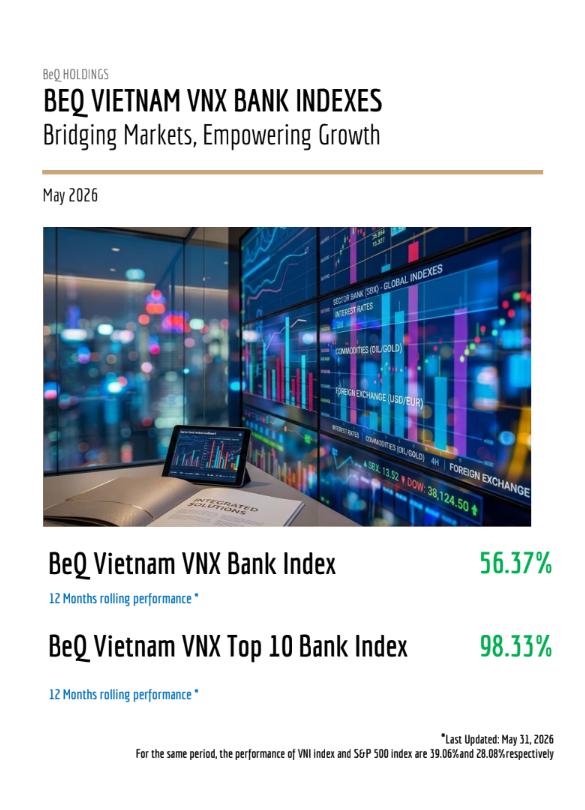
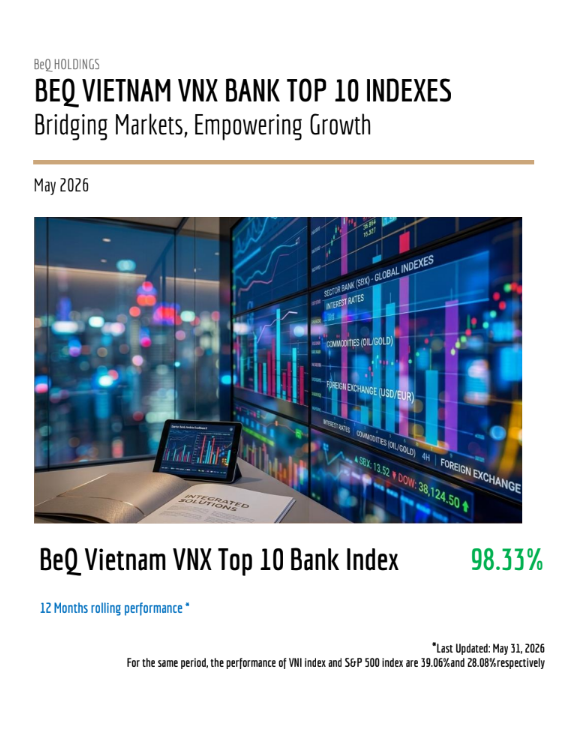
Vietnam’s banking sector sits at the center of the country’s financial transformation. As the nation prepares for its long‑awaited FTSE Russell upgrade to Secondary Emerging Market status in 2026, and as policymakers push ahead with plans to build International Financial Centers (IFCs) in Ho Chi Minh City, Da Nang, and Hanoi, no industry is more crucial—or more closely watched—than the banks that power national liquidity, credit expansion, and capital‑market development.
Though Vietnam’s banks have long been pillars of domestic finance, the shift toward emerging‑market status is redefining their role in ways the BeQ indexes capture with clarity: banks are no longer just lenders; they are becoming gateways for global capital, custodians of foreign flows, and infrastructure anchors for Vietnam’s planned IFC ecosystem.
Every major phase of Vietnam’s financial modernization has passed through its banks:
Foreign institutional participation requires scalable market access, clearing infrastructure, compliance systems, and liquidity buffers—all provided primarily by major banks.
Vietnam’s upgrade is expected to unlock billions in inflows, and banks will be the first to feel—and distribute—this liquidity wave.
For Vietnam to build IFCs capable of competing with Singapore or Hong Kong, it must offer: Cross‑border banking capabilities, Stable interbank markets, corporate finance expertise, Wholesale banking strength, Institutional‑grade custody services.
Banks are, therefore, not just participants in the IFC strategy, they are its core infrastructure.
Vietnam’s growth model remains deeply credit‑driven. Whether it’s manufacturing, real estate, logistics, or retail consumption, banking liquidity is the backbone of both corporate and retail expansion.
The BeQ VNX Bank Indexes quantify these dynamics, providing a clean, structured representation of a sector that drives—and reflects—Vietnam’s macro trajectory.
As Vietnam’s capital markets modernize and the country inches closer to IFC reality, the BeQ Vietnam VNX Bank Indexes will become indispensable—both as a benchmark and as a roadmap for interpreting Vietnam’s financial evolution.
The index is designed in accordance with international standards and is UCITS-compliant, making it suitable for supporting funds, ETFs, derivatives, and structured products.
BeQ VNX Sector Bank Index cover all eligible Vietnam Stocks following the BeQ index rule. The index is weighted by the full market capitalization, starting at 1,000 on the base date on December 31, 2008.
BeQ VNX Sector Bank Top 10 Index select the ‘best’ top 10 constituents of the BeQ VNX Sector Bank index in term of liquidity, and adjusted capitalization on free float. The index is weighted by the free float market capitalization, starting at 1,000 on the base date on December 31, 2008.
The Primary BeQ VNX Sector Bank Indexes are calculated in Price Return (PR) format, with Total Return (TR) and Net Return (NR) versions also available. The standard index currency is VND, while additional currency versions—such as AUD, CAD, CNY, EUR, GBP, HKD, JPY, KRW, SGD, USD, and USDC—are provided for overseas investors to reflect their actual performance.