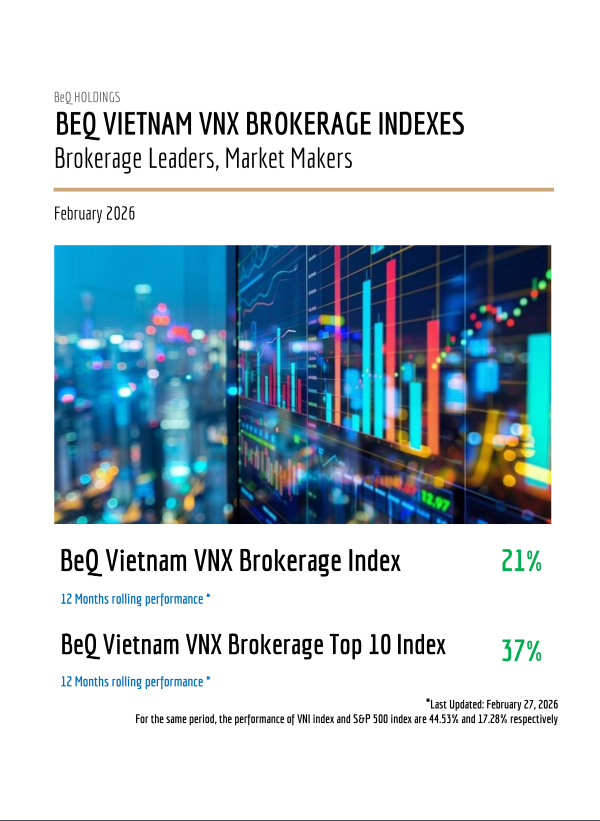
Vietnam’s financial markets are entering one of the most transformative periods in their history. With the nation officially set to be upgraded from Frontier Market to Secondary Emerging Market by FTSE Russell on September 21, 2026, global investors are turning their attention to one sector in particular—the brokerages that stand at the front line of capital flows. This moment of structural change has cast a spotlight on the BeQ Vietnam VNX Brokerage Indexes, one of the most revealing indicators of investor appetite, liquidity expansion, and Vietnam’s rapid financial modernization.
Vietnam’s upgrade is not symbolic. It is expected to trigger $3.5–$6 billion in passive inflows in the short term and potentially $25 billion by 2030, according to global institutions. HSBC projects inflows as high as $10.4 billion, driven by ETFs mimicking FTSE Emerging Market indexes—flows that must pass through Vietnam’s brokerages before reaching listed companies.
This influx is already visible. Vietnam’s VN‑Index soared nearly 50% in 2025, becoming Southeast Asia’s best‑performing market. Brokerage firms, often seen as the “thermometers” of liquidity, are now functioning as barometers of global confidence.
The BeQ VNX Brokerage Indexes capture this shift with precision. These indexes track the companies responsible for: Opening new investor accounts, facilitating foreign institutional flows, providing margin liquidity, Creating structured products, Executing ETF‑driven trading, Modernizing digital trading infrastructure.
Vietnam’s long‑term ambition is not just to join the Emerging Market club—it is to evolve from a regional trading hub into a credible International Financial Center (IFC). The government has signaled intentions to develop IFCs in Ho Chi Minh City, Da Nang, and Hanoi, aiming to position Vietnam alongside the likes of Singapore, Hong Kong, and Dubai.
For that vision to materialize, brokerages play an indispensable role:
BeQ’s Brokerage Indexes thus do more than measure performance—they track Vietnam’s readiness to operate as a global financial hub.
The index is designed in accordance with international standards and is UCITS-compliant, making it suitable for supporting funds, ETFs, derivatives, and structured products.
BeQ Vietnam VNX Brokerage Index cover all eligible Vietnam Stocks following the BeQ index rule. The index is weighted by the full market capitalization, starting at 1,000 on the base date on December 31, 2008.
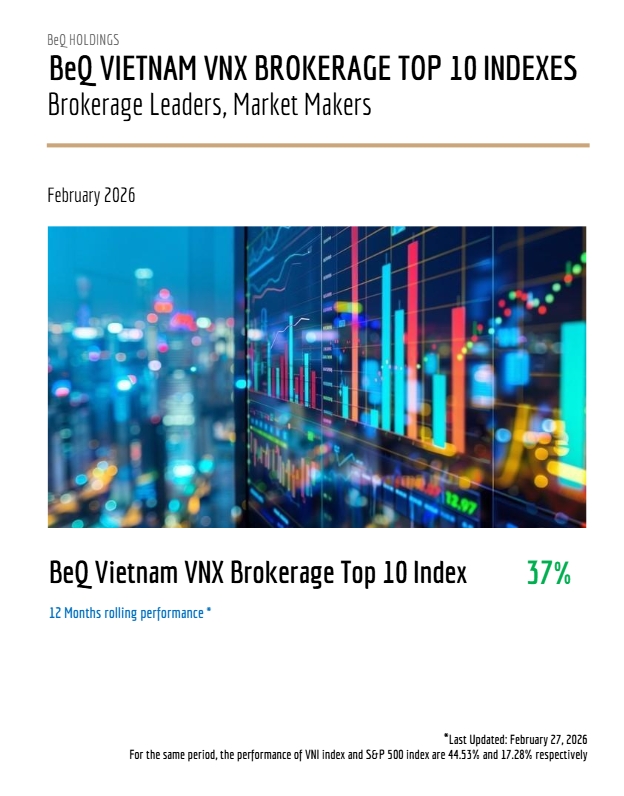
BeQ Vietnam VNX Brokerage Top 10 Index selects the ‘best’ top 10 constituents of the BeQ Vietnam VNX Brokerage index in terms of liquidity, and adjusted capitalization on free float. The index is weighted by the free float market capitalization, starting at 1,000 on the base date on December 31, 2008.
The Primary BeQ Vietnam VNX Brokerage Indexes are calculated in Price Return (PR) format, with Total Return (TR) and Net Return (NR) versions also available. The standard index currency is VND, while additional currency versions—such as AUD, CAD, CNY, EUR, GBP, HKD, JPY, KRW, SGD, USD, and USDC—are provided for overseas investors to reflect their actual performance.