The 2025–2026 period marks a pivotal phase as Vietnam moves closer to a potential FTSE Emerging Market upgrade. However, an upgrade is not a single event — it represents a structural reallocation of global capital.
If Vietnam is upgraded, several institutions estimate that USD 2–4 billion of passive ETF inflows could enter the market in the initial phase. These flows will not be evenly distributed. Capital will concentrate only in stocks that meet international standards on liquidity, free float, and foreign ownership availability.
Therefore, the key question is not whether the market will rise — but whether:
Is your portfolio positioned where ETF capital is likely to flow?
The BeQ Superstar Index is designed to answer this question using data — not sentiment.
When a country is added to the FTSE Emerging Market index, ETFs tracking the benchmark must allocate capital according to index weights. This creates:
Based on FTSE Russell observations and emerging market data, ETF inflows typically begin 6–12 months before the official upgrade.
Examples:
This implies that portfolio positioning is happening now — not after the upgrade.
Three key infrastructure factors are closely monitored by FTSE and global funds:
These developments may not trigger short-term price movements, but they are decisive in determining whether ETF capital can enter Vietnam.

ETF inclusion follows a strict screening framework. In reality, most listed stocks fail to pass.
Core ETF Selection Criteria
|
Filter Layer |
ETF Requirement |
Implication |
|
Liquidity |
High and stable trading volume |
Enables large-scale capital deployment |
|
Foreign Ownership Room |
Available capacity for foreign investors |
Allows real participation from global funds |
|
Free Float |
Sufficient public float |
Ensures sustained index eligibility |
|
Market Capitalization |
Meets Emerging Market thresholds |
Avoids index exclusion |
|
Sustainability |
Long-term investability |
Not purely expectation-driven |
Many investors assume an upgrade lifts the entire market. History suggests that most individual portfolios are not positioned in ETF-targeted stocks.
The BeQ Superstar Index does not attempt to predict market direction. Instead, it models the allocation logic of ETF capital to identify stocks that:
Screening methodology includes:
The objective is not to outperform the market through speed — but to stand where capital is structurally likely to arrive.
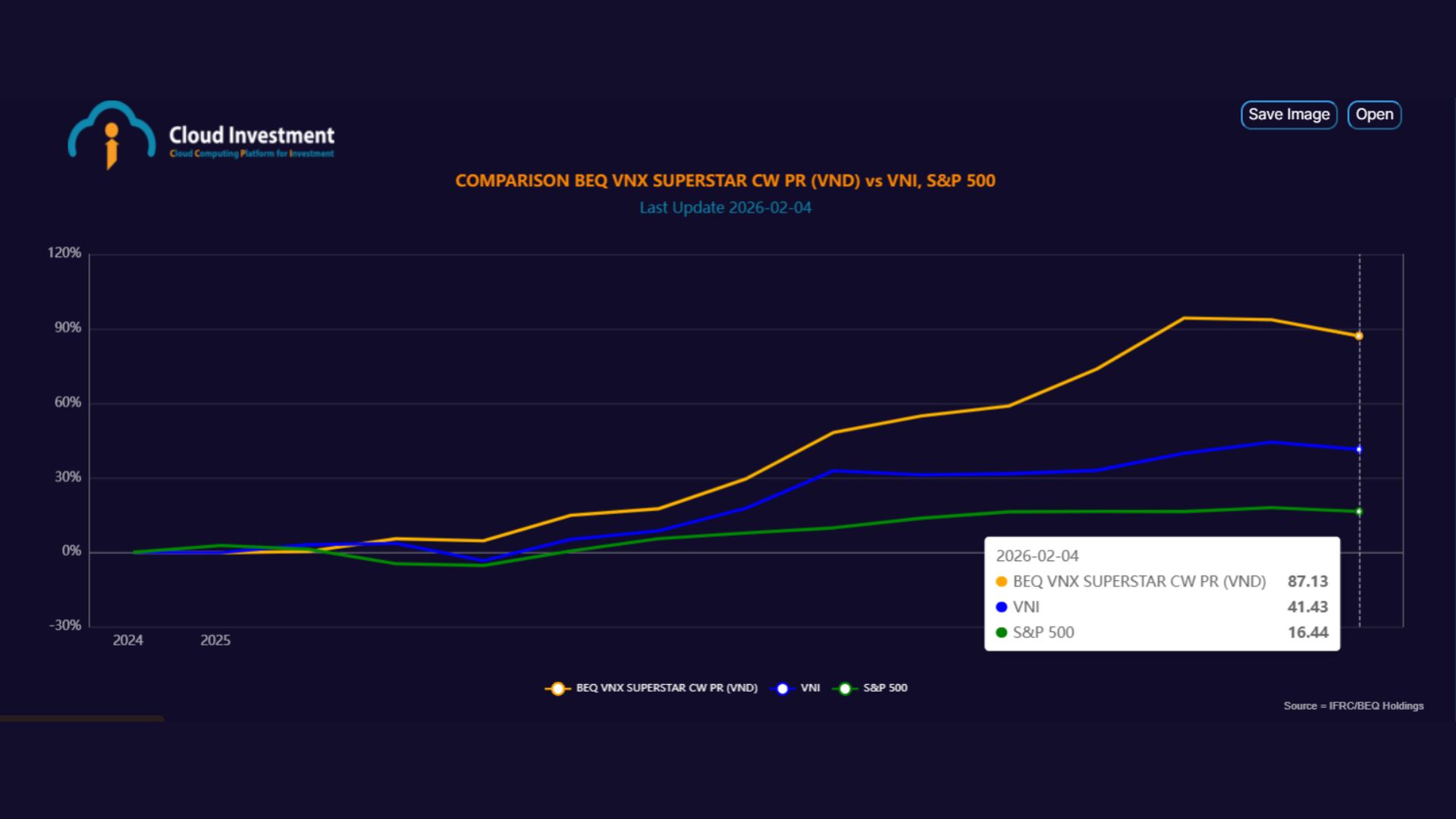
As illustrated in comparative performance data, while the broader market (VN-Index) delivered steady growth, a portfolio filtered using the BeQ Superstar methodology captured foreign capital flows more effectively, generating an 87.13% return — nearly double the benchmark.
Statistics across multiple emerging markets show:
Long-term simulation indicates that portfolios aligned with FTSE criteria demonstrate:
Sustainable alpha is not defined by short-term price increases — but by consistent outperformance over time.
In practice, the BeQ Superstar Index functions as:
An FTSE upgrade is not a short-term rally — it is a structural shift in global capital allocation.
The opportunity will favor investors who:
When the upgrade occurs, the market will not wait for investors to prepare.
Portfolios already positioned correctly will benefit immediately.
The BeQ Superstar Index does not forecast the market.
It helps investors align portfolios with real capital flow structures ahead of the FTSE 2026 cycle.
Assess whether your portfolio is positioned within the ETF-targeted universe — before the market fully reflects it.
Contact BeQ Holdings for further information
Text box item sample content