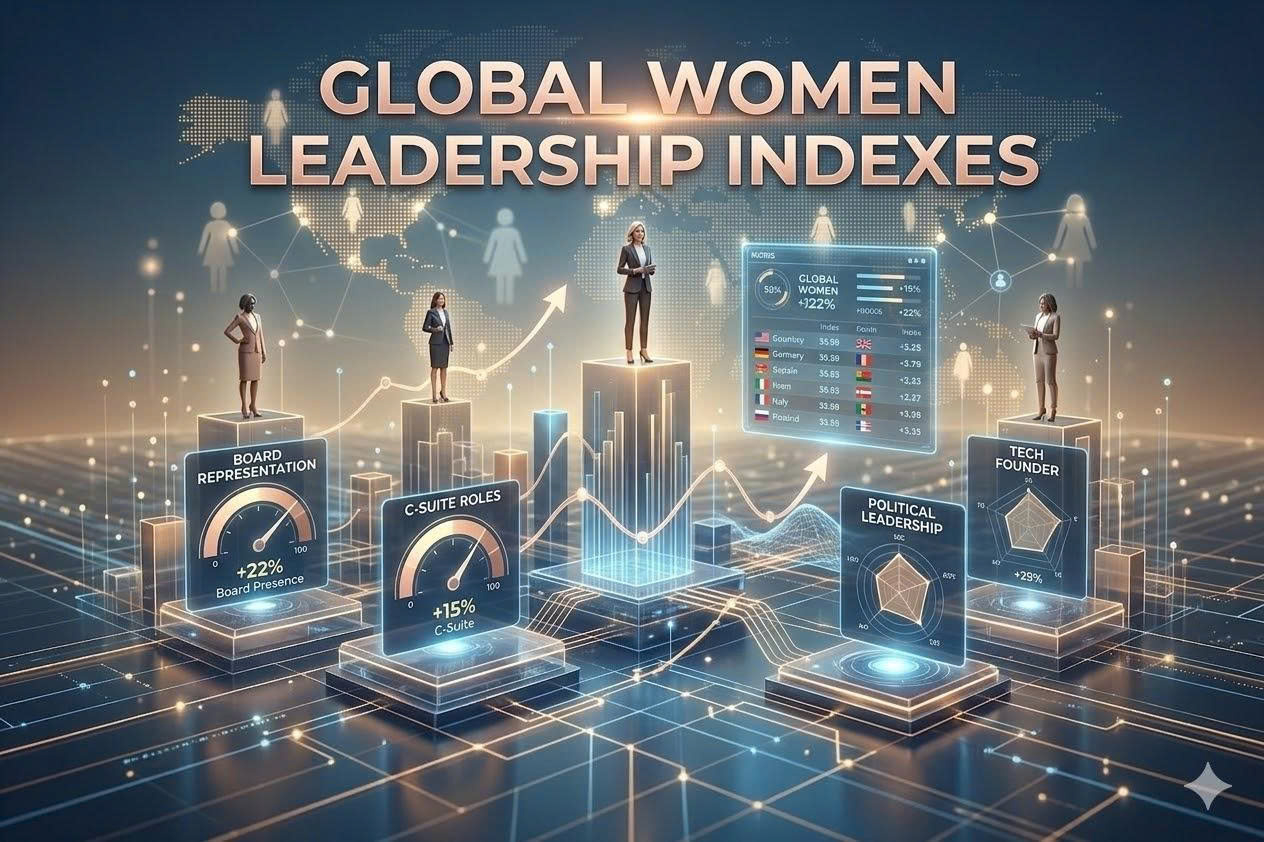
In a world where economic influence and political authority remain unevenly distributed, a growing constellation of global indexes is reshaping how we measure women’s leadership. These benchmarks—spanning corporate boardrooms, C‑suites, parliaments, and statehouses—offer an increasingly data‑rich portrait of gender representation. Together, they not only capture progress but illuminate the structural barriers that continue to stall parity.
Government at a Glance: Global Leadership Beyond the Boardroom
Women’s leadership is not confined to the private sector. The Wilson Center’s Global Women’s Leadership Index positions government as a critical arena where “numbers matter”—offering one of the earliest and most comprehensive snapshots of women’s political participation globally. The project tracks representation across multiple layers of governance and highlights the persistent gaps in global public leadership.
Complementing this is the Women Leaders Index from the Global Government Forum. This dataset examines women’s presence in senior civil‑service positions across the G20, EU, and OECD, enabling direct comparisons among countries and regions. Interactive visuals reveal how nations diverge sharply in public‑sector gender equity—often at rates distinct from their corporate environments.
The broader takeaway: government progress remains uneven, but where representation rises, so too does policy responsiveness on equity, social welfare, and democratic inclusion.
If corporate metrics chart controls capital, the Women’s Power Index from the Council on Foreign Relations tracks who writes laws, shapes policy, and governs nations. Ranking 193 UN member states, the index assesses women’s presence across heads of state, legislatures, cabinets, and local government.
As of January 2026, the index includes real‑time listings of female presidents and prime ministers—from Iceland to India—offering not just comparative data but a live window into the gender dynamics of global governance.
Its findings reveal a sustained plateau: after two decades of progress, the number of countries with strong female political representation has stalled, underscoring the fragility of gains.
Tracking Female‑Led Corporations: IFRC/BeQ Women Leadership Series
In global conversation on corporate power, the numbers tell a story that is at once encouraging and sobering. The BeQ Women Leadership Indexes—an emerging conceptual framework that blends the measurement of women in CEO roles with women’s presence on corporate boards—capture a truth the world is only beginning to reckon with: progress for women in leadership is real, measurable, and still frustratingly slow.
Together, the data from Women CEO Indexes and Women on Board Indexes form a panoramic view of leadership inequality—one that highlights where advancements are taking hold and where entrenched systems continue to resist change.
Vietnam Women CEO indexes were launched in 2013, their history is recalculated backwards from 2008-12-31, and are available in Price version, and Total Return version (including dividends), and converted in several currencies, in particular VND, USD, EUR, JPY, AUD, CAD, …
IFRC Women CEO Vietnam Indexes Series comprise: