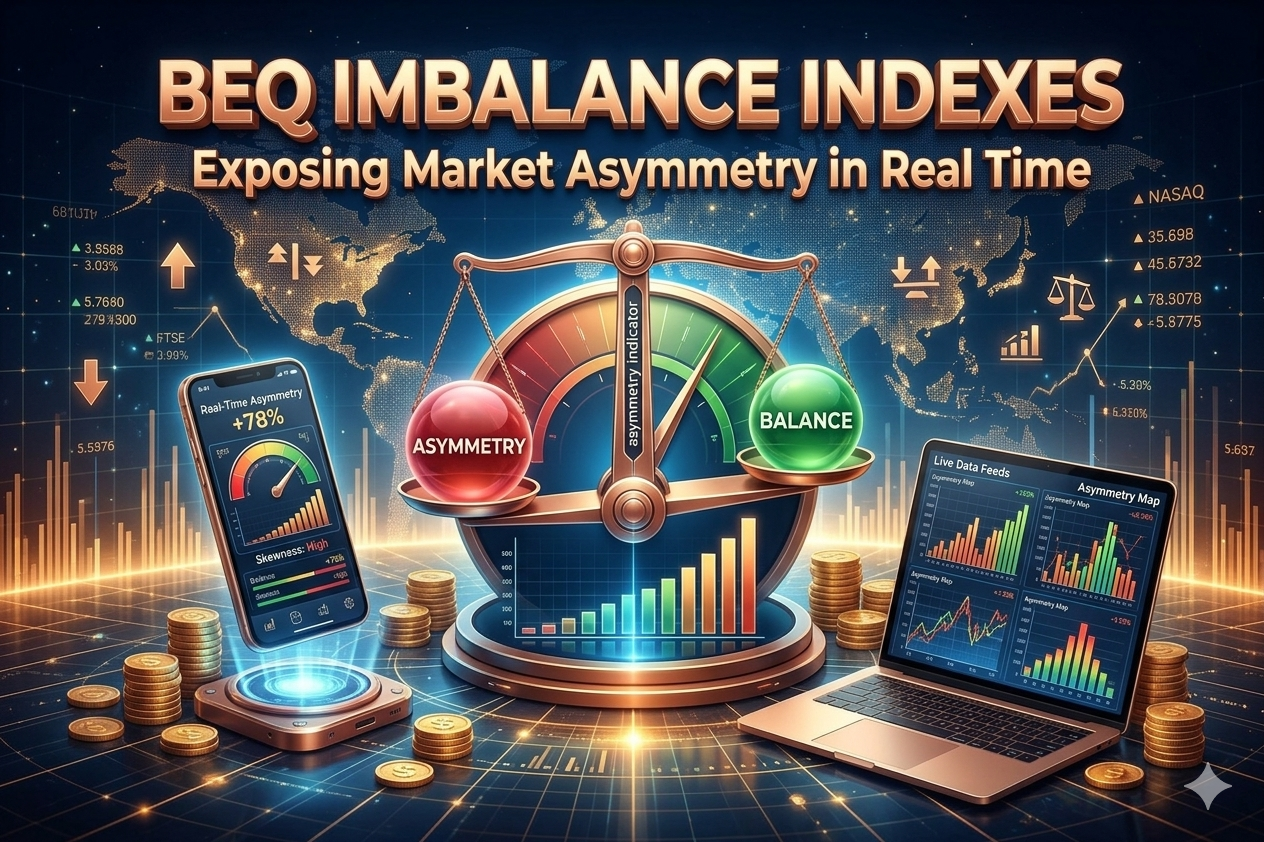
BEQ IMBALANCE INDEXES
BeQ Imbalance Indexes: Exposing Market Asymmetry in Real Time
In an era dominated by algorithmic decision‑making, rapid‑fire order flows, and the increasingly psychological nature of investing, BeQ Holdings is challenging how the financial world interprets market structure. Their Imbalance Indexes—part of the broader BeQ_Indexes_Family.pdf—aim not to mirror the market, but to decode it, revealing distortions and undercurrents that traditional benchmarks overlook. [BeQ_Indexes_Family | PDF]
A New Lens for a New Market
While conventional indexes track price levels or sector performance, BeQ’s Imbalance Indexes spotlight the moments when markets fall out of equilibrium—the subtle shifts in liquidity, behavior, and capital positioning that often precede dramatic moves long before they appear on charts.
These indexes treat imbalances not as noise, but as signals—evidence that trading pressure, sentiment, or structural forces are pulling the market in directions most investors fail to notice.
What These Indexes Reveal
The BeQ Imbalance Indexes monitor a spectrum of distortions, each capturing a different dimension of instability:
- Liquidity Gaps: Abrupt disappearances of volume that often foreshadow volatility spikes.
- Order Book Asymmetries: Lopsided buy‑sell dynamics pointing to latent directional momentum.
- Behavioral Biases: Herding, capitulation, euphoria—psychological extremes reflected in order flow.
- Sectoral Overconcentration: The buildup of capital in specific themes, signaling fragility or overextension.
- Capital Flow Distortions: Unusual institutional or cross‑border flows hinting at macro‑level repositioning.
Each imbalance is a clue to what the market is really thinking—or fearing.
The Engine Behind the Indexes
Powered by BeQ’s cloud platforms—CCPR for research and CCPI for investable strategies—these indexes rely on a multi‑factor model that blends structural and behavioral signals in real time.
Key Components
- Volume‑Weighted Order Flow
Captures not just where trades occur, but their intensity, exposing pressure points beneath surface‑level price action.
- Volatility Clustering
Identifies pockets of turbulence that often emerge when markets are struggling to rebalance.
- Sentiment Divergence
Integrates insights from BeQ’s Emotional Indexes to detect when mood and movement conflict—a classic tell of irrational markets. [LAYOUT_BRO…ENERAL_08p | Word]
- Sectoral Rotation Metrics
Tracks capital migrations between industries, surfacing overbought or neglected segments.
- Cross‑Asset Correlation Breakdown
Flags moments when asset classes uncouple—signals that often accompany stress or reveal contrarian opportunities.
Together, these metrics form a framework that is both quantitative and psychological, capturing how markets behave—not just how they trade.

Implications
- Early Warning System: Market imbalances frequently surface before headlines do. By highlighting structural cracks early, the indexes help traders position ahead of major swings.
- A Behavioral Finance Breakthrough: By fusing sentiment and structure, BeQ offers one of the market’s first
- Better Risk Management: Imbalances spotlight hidden vulnerabilities: crowded trades, liquidity traps, overheated sectors. Portfolio managers can adjust exposures before stress manifests.
- Alpha in the Anomalies: Mispricings often emerge when markets lose balance. The indexes translate these inefficiencies into actionable signals for traders and quants.
- Transformative Educational Value: Within BeQ’s Virtual Trading Platform, students can see market mechanics unfold in real time, bridging academic theory with live microstructure behavior.
How Professionals Apply These Indexes
- Traders monitor imbalance alerts to refine entry and exit timing during high‑signal environments.
- Portfolio Managers adjust allocations in response to sectoral or capital flow stresses.
- Quant Researchers embed imbalance metrics into predictive models for sharper signal generation.
- Educators use imbalance scenarios to teach market psychology, structure, and decision‑making.