Over the past two decades, more than USD 10 trillion has moved away from individual stock selection.
This capital has not been searching for “better companies,” but for a more efficient capital allocation mechanism. The center of gravity in financial markets has shifted away from individual securities toward index-based allocation frameworks—implemented through ETFs and index funds.
According to aggregated data from BlackRock, Bloomberg, and Statista, global ETF assets under management (AUM) have surpassed USD 10 trillion and continue to grow steadily across market cycles. This is not speculative capital. It reflects a structural change in how institutional money operates.
So what exactly is an ETF, and why has it become a core instrument of modern financial markets?
An ETF (Exchange-Traded Fund) is an investment fund listed and traded on an exchange, designed to closely replicate the performance of a predefined basket of assets—most commonly an index.
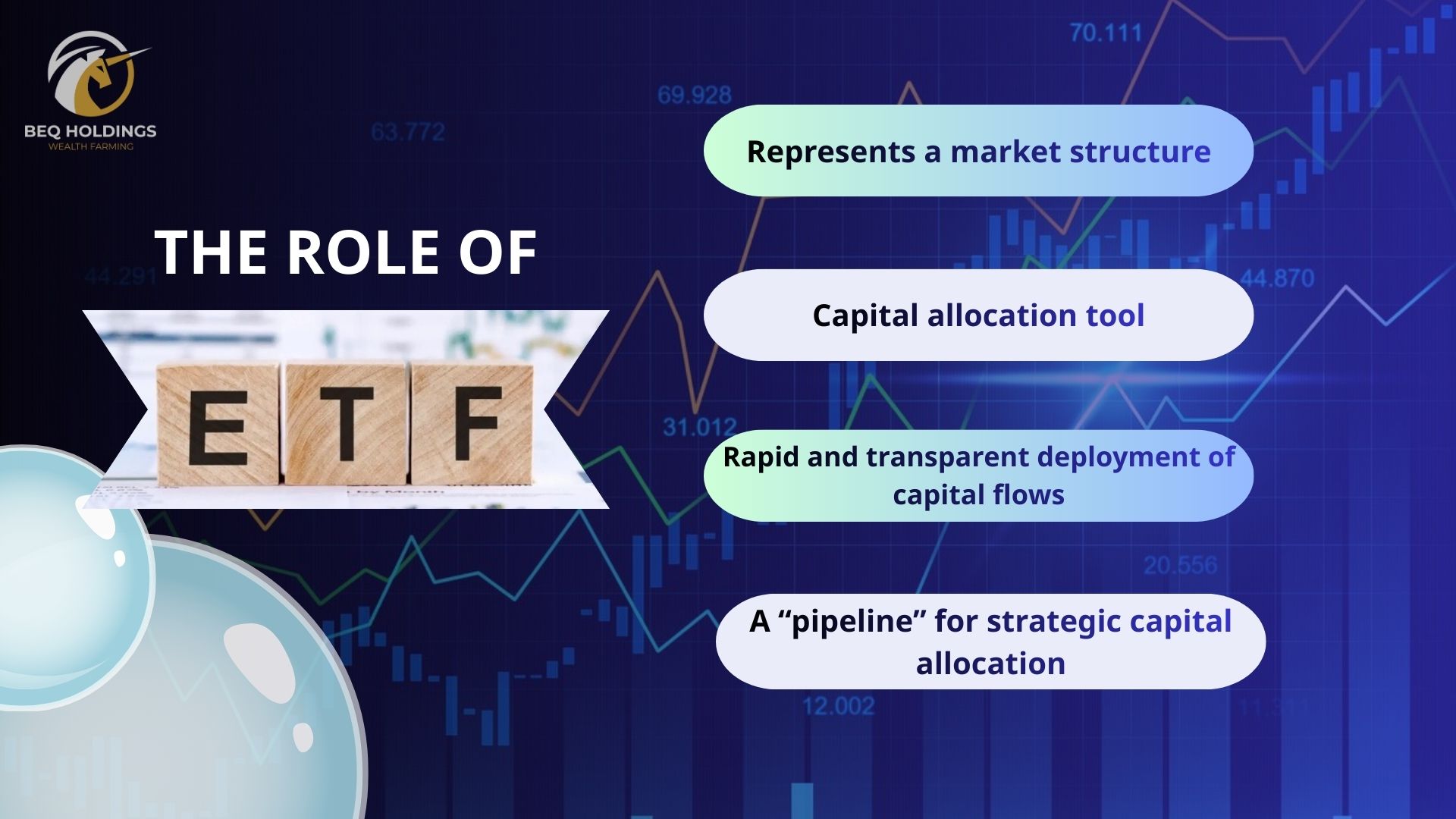
Unlike an individual stock, which represents a single company, an ETF represents an entire market structure, such as:
At its core, buying an ETF is not a bet on the growth potential of a single company. It is participation in capital flows moving through a standardized allocation structure.
The critical point is this:
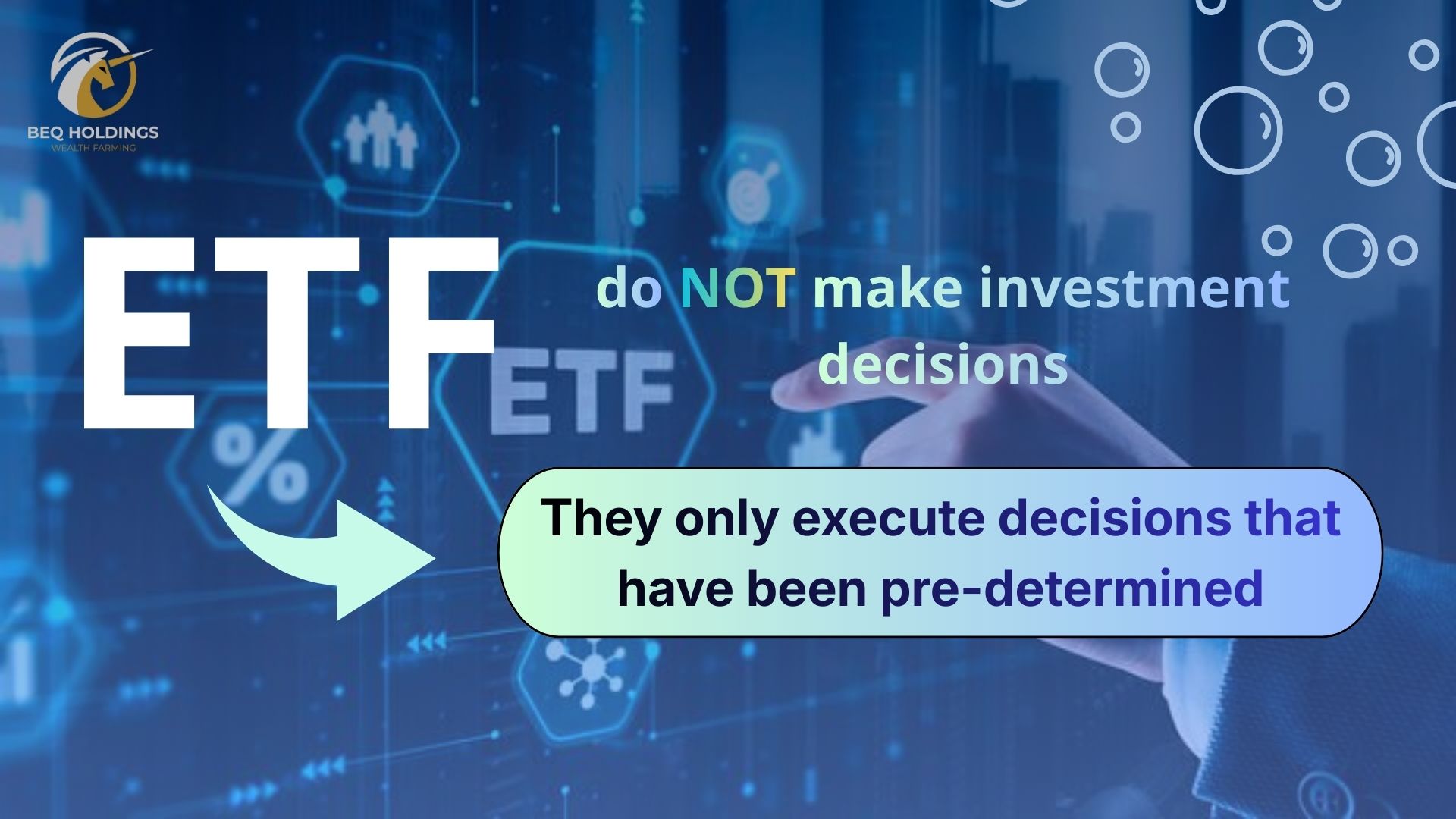
ETFs do not make investment decisions. ETFs only implement decisions that have already been made.
Portfolio constituents, weighting schemes, and rebalancing schedules are not determined by discretionary fund managers. They are governed by a predefined ruleset. When those rules change, the ETF must adjust accordingly—regardless of market conditions or subjective views.
This is precisely why ETFs have become:
ETFs are not the decision-making center of the market, but they are an indispensable operational component of its infrastructure.
When markets were fragmented, company-level analysis could generate meaningful edge. As markets globalized, the nature of the investment problem fundamentally changed.
Today:
In this environment, decisions driven by emotion, subjective judgment, or personal conviction become systemic risks.
ETFs emerged as a structural solution:
ETFs do not make markets “smarter.” They make markets operate more efficiently at scale.
A widely held belief is:
“When ETFs are buying, smart money is entering the market.”
This confuses cause and effect.
ETFs are not where investment decisions originate.
They are the final execution layer of decisions made at a higher strategic level.
This explains why:
A lesser-known paradox is that ETFs are highly flexible for investors, yet extremely rigid in their operation.
ETFs:
When index composition changes, ETFs must trade—regardless of market conditions.
This forced passivity creates:
For large institutions, ETFs are not alpha-generating tools. They are:
ETFs help institutions:
At sufficient scale, stability outweighs flexibility.
ETFs reveal where capital has been deployed.
They do not determine where capital should go.
All meaningful decisions are made earlier—at the index level and within the capital allocation framework.
To truly understand ETFs, the key question is not “What are ETFs buying?” but:
Which index is being used for capital allocation—and under what rules?
This is where traditional analysis often stops—and where institutional capital allocation truly begins.
CCPI is designed to help investors:
If you want to understand why ETFs are compelled to buy or sell, CCPI provides that structural perspective:
🔗 https://ccpi.vn/
Understanding structure is one thing.
Observing that structure in action is another.
Dashboard Lite transforms CCPI index data into:
For investors who want to observe how index-driven capital flows evolve in practice, Dashboard Lite is the logical next step:
🔗 https://dashboardlite.ccpi.vn/
ETFs are a pillar of modern financial markets—but they are not where decisions begin.
Investors truly understand ETFs when they:
ETFs show where capital is today.
Understanding the structure behind ETFs reveals where capital is likely to move next—an issue explored further in the next article, “What Are Index Funds?”
Contact BeQ Holdings for consultation
Hotline: +84 941 753 139
Email: contact@beqholdings.com
Text box item sample content