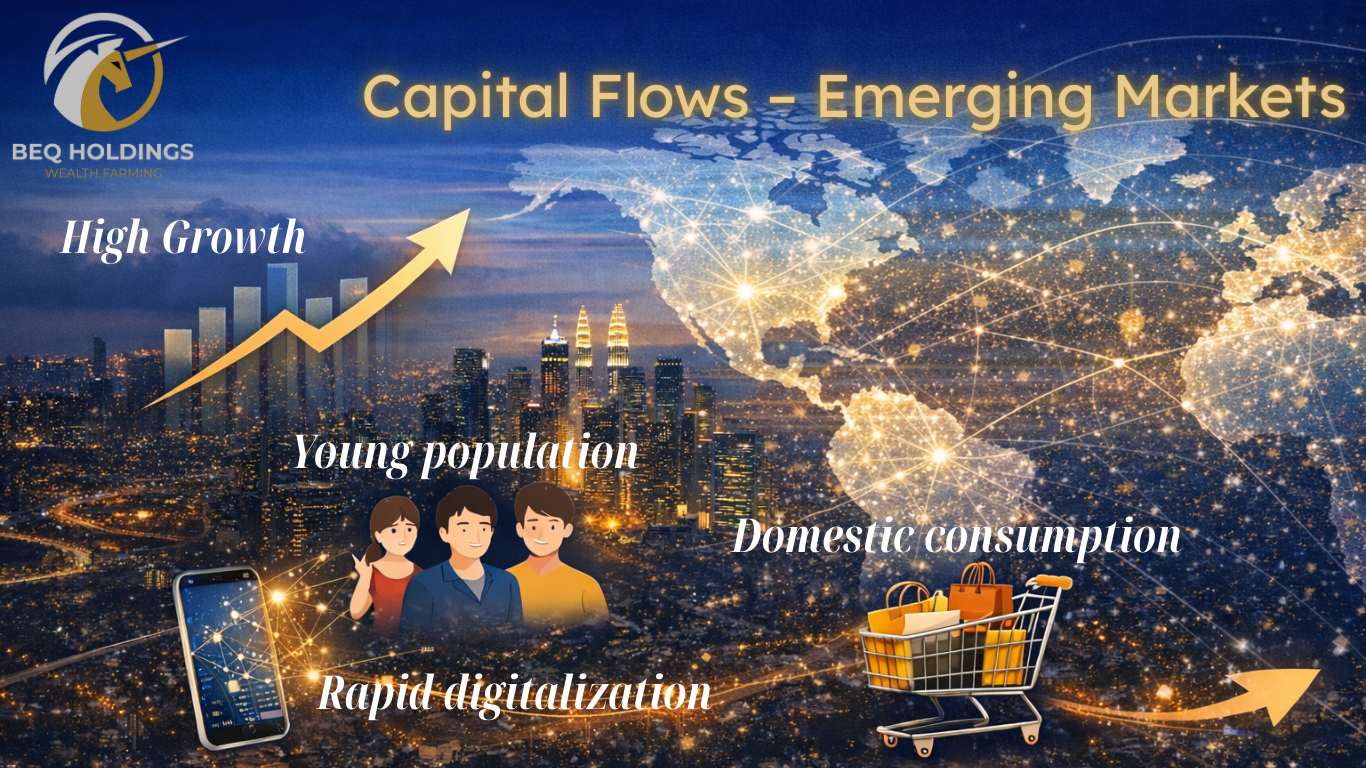
In a period of heightened global economic volatility, international capital has not “disappeared” but is instead being reallocated according to new structural patterns. Recent reports from the IMF and various financial institutions indicate that capital flows into emerging markets have recovered to levels comparable to 2018, prior to the series of consecutive global crises.
This return is not a short-term reaction, but rather reflects a structural shift in how global capital seeks growth. Emerging markets – supported by strong growth fundamentals, young populations, rapid digitalization, and expanding domestic consumption – are increasingly becoming the focal point of long-term investment strategies.
In this context, the role of data analysis, strategic design, and risk management institutions such as BeQ Holdings is becoming increasingly critical. They enable investors not only to observe trends, but to truly understand the underlying mechanics of capital flows.
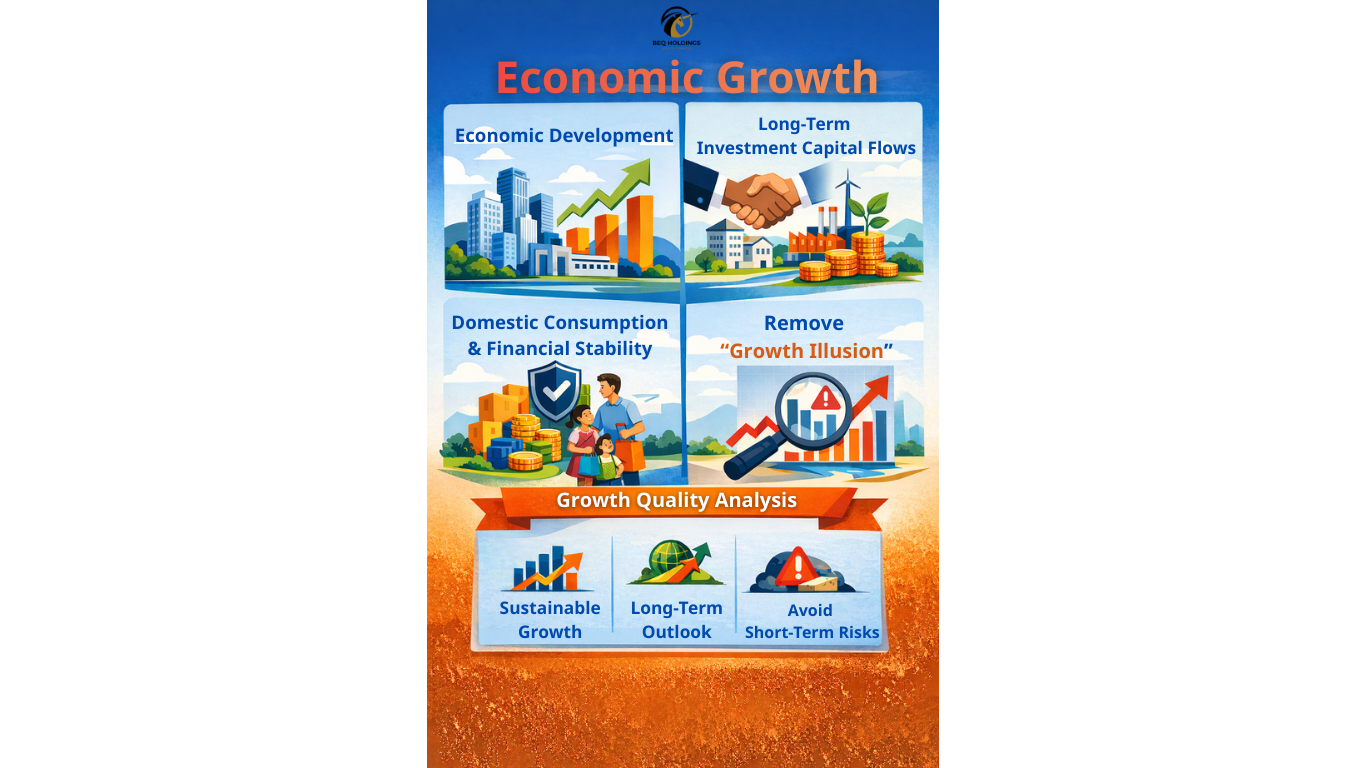
One of the core reasons global capital continues to flow into emerging markets is their superior and more structurally driven economic growth compared to developed economies. While many developed countries face prolonged low growth, high public debt, aging populations, and shrinking policy flexibility, emerging markets are positioning themselves as structural growth alternatives.
In reality, most emerging economies continue to maintain GDP growth rates above the global average, driven not only by labor cost advantages or population size, but increasingly by a transition toward domestic consumption, services, and technology. This shift is a key reason long-term capital is returning, despite ongoing global financial uncertainty.
According to recent reports, capital inflows into emerging markets (excluding China) have reached approximately USD 110 billion, equivalent to around 0.6% of economic output, the highest level since 2018. This figure reflects not only a recovery in scale, but more importantly, renewed investor confidence in the resilience and expansion capacity of emerging economies over the medium and long term.
However, from a strategic perspective, BeQ Holdings believes that economic growth should not be evaluated solely by GDP growth rates. In practice, two economies with identical growth figures can deliver vastly different investment value. What truly matters is the quality and structure of growth.
Growth driven by domestic consumption, private investment, and productivity improvements is more sustainable than growth overly dependent on exports or government spending. Emerging markets are gradually shifting toward demand-driven growth models, reducing exposure to global economic cycles and external shocks.
Fast-growing economies accompanied by large fiscal deficits, high inflation, or inflexible monetary policy pose significant risks to capital. In contrast, emerging markets that have strengthened fiscal discipline, controlled inflation, and improved policy transparency are better positioned to retain long-term capital.
Not all capital inflows carry the same value. Foreign direct investment and capital directed toward production, infrastructure, and technology signal long-term confidence. Short-term speculative flows may generate surface-level growth but can exit quickly when global financial conditions shift.
For this reason, BeQ Holdings approaches economic growth through a multi-dimensional analytical framework, integrating macroeconomic data, capital flows, sector structures, and financial indicators to assess the true nature of growth. This approach enables investors to:
As global capital becomes increasingly selective and risk-conscious, growth quality has become the decisive factor determining whether capital stays or exits. This principle forms the foundation upon which BeQ Holdings designs asset allocation strategies—helping investors capture opportunity while investing in economies that grow in a healthy and sustainable manner.
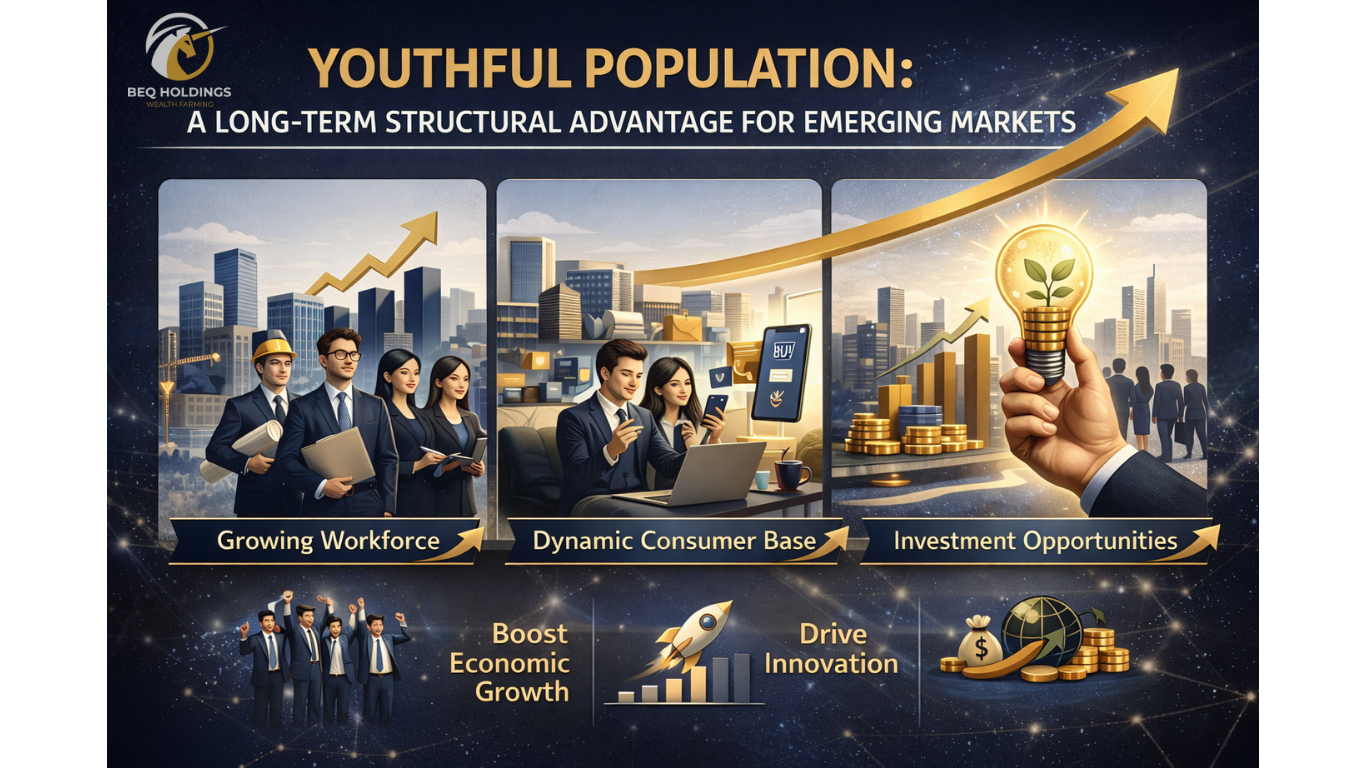
Beyond economic growth, a young demographic structure is one of the most fundamental factors positioning emerging markets as attractive long-term destinations for global capital. While many developed economies are rapidly aging and facing labor shortages and rising social welfare pressures, most emerging markets continue to benefit from large, growing, and youthful workforces.
Young populations not only expand labor supply but also create a dual economic engine: boosting both production and consumption. This foundation allows emerging economies to sustain growth over decades rather than relying on short-term cycles.
A young population only creates value when supported by education, skills development, and adaptability to the digital economy. Markets that invest heavily in education and workforce reskilling are better positioned to enhance productivity and attract high-value manufacturing and technology investment.
If young labor forces are not absorbed into the formal economy, they may become social and economic risks. Conversely, emerging markets with dynamic private sectors, supportive entrepreneurship ecosystems, and pro-business policies can transform youthful labor into long-term growth engines.
Young consumers in emerging markets are more open to technology, e-commerce, digital finance, and new consumption models. This creates entirely new consumer markets, attracting capital into retail, technology, finance, and service sectors.
At BeQ Holdings, demographic analysis goes beyond population statistics. The focus lies in evaluating a market’s ability to convert young demographics into tangible economic growth and investment value. By assessing labor structures, next-generation consumption trends, and policy capacity, BeQ Holdings helps investors identify markets where demographic advantages can translate into sustainable long-term returns.
A defining difference between today’s emerging markets and previous cycles is the increasingly central role of technology. Rather than developing sequentially like advanced economies, many emerging markets are leveraging technology to leapfrog development stages, shorten growth timelines, and create entirely new economic models.
Technology not only improves productivity but reshapes entire economic structures—from finance and retail to logistics, education, and healthcare. This explains why investment capital, particularly private and strategic capital, is increasingly focused on emerging markets with dynamic technology ecosystems.
Digital banking, fintech, and payment platforms are expanding financial access to millions previously excluded from traditional banking systems. This not only stimulates consumption but also expands the formal economy, unlocking additional growth capacity.
Unlike developed markets where technology often delivers marginal improvements, in emerging markets it addresses fundamental needs: payments, transportation, commerce, education, and healthcare. This enables rapid scaling and attracts long-term capital.
The combination of a young population and rapid access to technology has given rise to a new generation of enterprises – agile, innovative, and capable of scaling across the region. This is a key factor that makes emerging markets the new global hubs of technological growth.
BeQ Holdings views technology not merely as an investment sector, but as a value multiplier for the entire economy. By analyzing digitalization levels, technological infrastructure, and regulatory environments, BeQ Holdings helps investors identify markets where technology supports sustainable growth rather than short-lived technological hype.
Alongside economic growth, demographics, and technology, domestic consumption is becoming the most critical pillar attracting capital to emerging markets. As per capita income rises and the middle class expands rapidly, consumption growth is shifting not only in volume but in quality.
Unlike export-dependent growth models, domestic consumption provides greater stability and resilience against global volatility. This is why many investors view domestic consumption as a long-term anchor for capital in emerging markets.
Rapid middle-class growth generates sustained demand for housing, education, healthcare, travel, financial services, and value-added services—forming the backbone of long-term economic stability.
Consumers in emerging markets are increasingly prioritizing experience, convenience, and quality rather than focusing solely on price. This shift creates significant opportunities for businesses and investment capital flowing into service sectors, modern retail, and digital consumption.
Today, domestic consumption is closely tied to e-commerce, digital payments, and technology platforms, enabling faster and more efficient market expansion. This further strengthens the attractiveness of emerging markets to global investment flows.
BeQ Holdings views domestic consumption as a strategic indicator of economic health, rather than merely a reflection of short-term growth. By analyzing income levels, consumer behavior, and spending trends, BeQ Holdings helps investors identify markets with sufficiently strong consumption foundations to sustain long-term growth, thereby developing investment strategies aligned with sustainable objectives.

As global capital increasingly turns toward emerging markets while becoming more selective and risk-aware, the role of investment strategy and advisory institutions extends beyond information delivery to transforming data into structured investment decisions. This is precisely where BeQ Holdings builds its core capabilities.
Rather than chasing short-term trends, BeQ Holdings develops a solution framework built around three strategic pillars aligned with emerging markets characteristics and the evolving needs of medium- to long-term investors.
BeQ Holdings approaches emerging markets from a macros – structural perspective, where investment decisions are contextualized within broader economic growth, policy environments, and capital cycles.
Rather than focusing on isolated indicators, BeQ Holdings builds its analytical capabilities around:
This approach enables an assessment of the market’s underlying health, distinguishing cyclical recoveries from structural growth trends. For investors, this is a critical factor in avoiding emotion-driven decisions or those based on short-term signals.
One of the greatest challenges in investing in emerging markets is their complexity and lack of uniformity across countries. Recognizing this, BeQ Holdings focuses on designing indicators, analytical frameworks, and evaluation models to standardize the investment decision-making process.
These models help to:
Through this, BeQ Holdings supports investors in shifting from a “trend-driven” mindset to a “structure-driven” approach, where every investment decision is grounded in data and clear strategic logic.
For BeQ Holdings, investing in emerging markets is not about selecting a single “hot” market, but about long-term asset allocation. Accordingly, the firm’s focus is on helping investors access emerging markets in a disciplined and controlled manner in order to:
As a result, investors can not only capture growth potential but also mitigate risks arising from policy changes, interest-rate movements, and global economic cycles.

BeQ Holdings helps investors distinguish between genuine, sustainable growth and superficial, trend-driven growth in emerging markets through a structure-based investment mindset, rather than chasing short-term trends.
Each market is analyzed as a distinct ecosystem, grounded in growth drivers, demographic and consumption structures, technological foundations, and policy capacity. By integrating macroeconomic data, capital-flow analysis, and cyclical risk management, BeQ Holdings supports the development of systematic asset allocation strategies aligned with investors’ risk appetite and long-term objectives.
The core value lies in transforming the growth potential of emerging markets into disciplined, sustainable, and adaptive investment strategies over time.
You don’t just need to see where capital flows – you need to understand how it moves.
BeQ Holdings partners with investors to analyze emerging markets, assess the quality of growth, and build sustainable asset allocation strategies.
👉 Contact BeQ Holdings to receive strategic investment advice tailored to your long-term goals.
Text box item sample content