Vietnam’s FTSE upgrade is more than a symbolic reclassification—it is expected to bring billions in automatic ETF and index‑tracker inflows. These flows depend heavily on the infrastructure provided by financial‑services companies: investment banking and capital raising, securities services and custody, insurance and risk solutions, asset management, valuation, advisory, and financial data services.
As inflows increase, the companies operating these functions will be among the first to scale.
Financial‑services companies are structurally tied to those trends: whenever liquidity rises, corporate activity expands, or investor participation spikes, financial‑services firms sit directly at the point of impact.
Vietnam’s long‑term ambition to establish International Financial Centers (IFCs)—particularly in Ho Chi Minh City and Da Nang—depends on the strength and sophistication of its financial‑services sector.
For Vietnam to compete with Singapore, Hong Kong, or Dubai, it must offer: modern custody and clearing infrastructure, international-standard insurance and reinsurance processes, research and data services, cross‑border advisory capabilities, asset‑management depth and product diversity.
These functions exist primarily within the financial‑services companies tracked by the VNX Financial Services Indexes.
IFCs thrive where corporate finance is dynamic—M&A, IPO pipelines, restructuring advisory, and capital raising.
These activities rely on diversified financial‑services firms—not just on banks or brokerages.
Modern IFCs Are Anchored by Asset‑Management Activity
ETFs, mutual funds, pension funds, insurance pools, and wealth‑management platforms are core engines of IFC liquidity. Vietnam’s financial‑services companies are expanding these offerings rapidly, preparing for an influx of foreign and domestic capital.
The BeQ Financial Services Indexes therefore function not only as sector benchmarks but as roadmaps, illustrating how quickly Vietnam is building the scaffolding of an international financial hub.
The index is designed in accordance with international standards and is UCITS-compliant, making it suitable for supporting funds, ETFs, derivatives, and structured products.
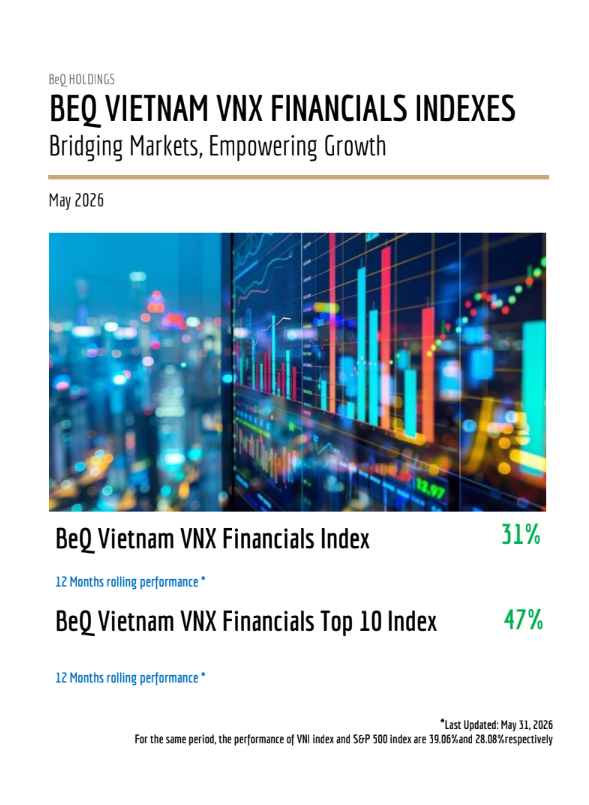
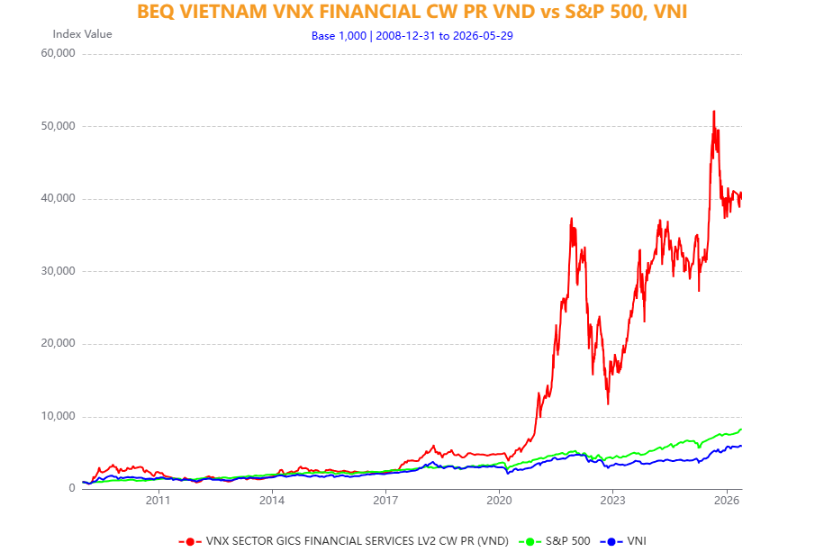
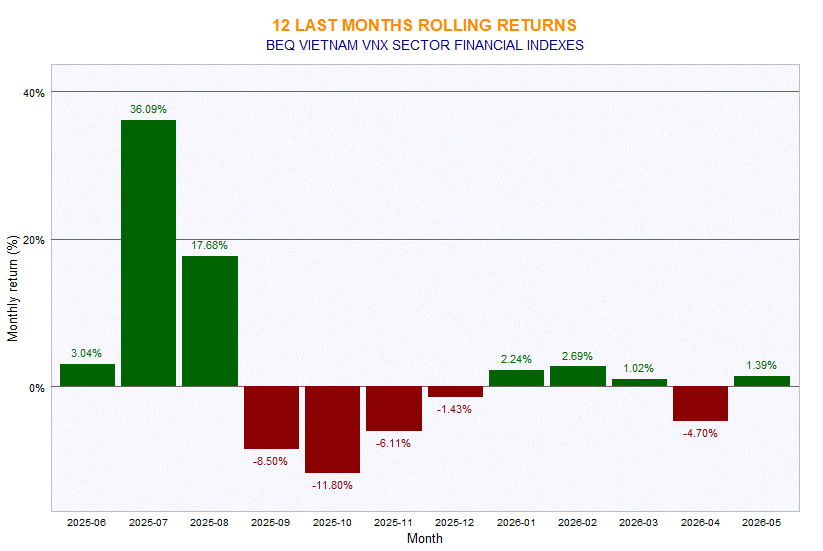
BeQ Vietnam VNX Financials Index cover all eligible Vietnam Stocks following the Global Industry Classification Standard (GICS). The index is weighted by the full market capitalization, starting at 1,000 on the base date on December 31, 2008.
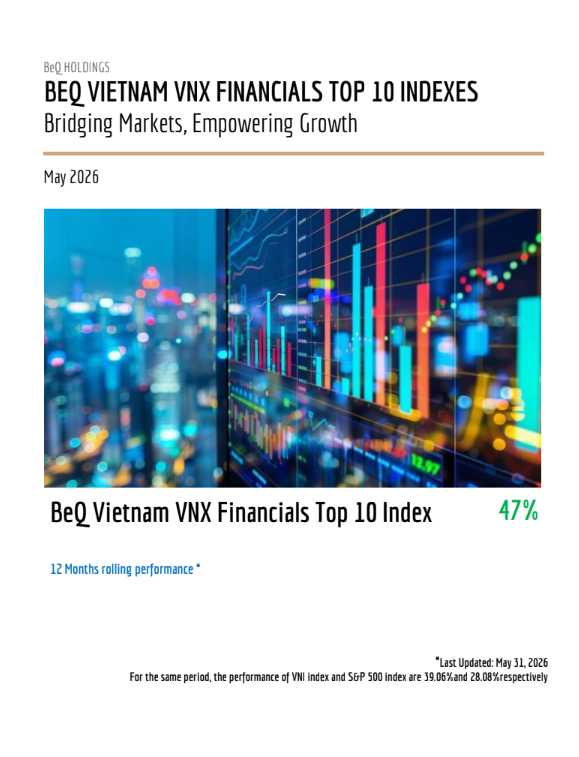
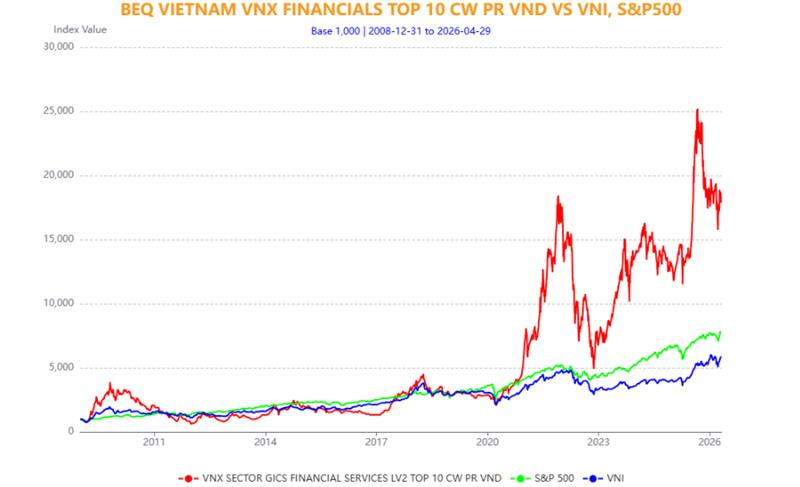
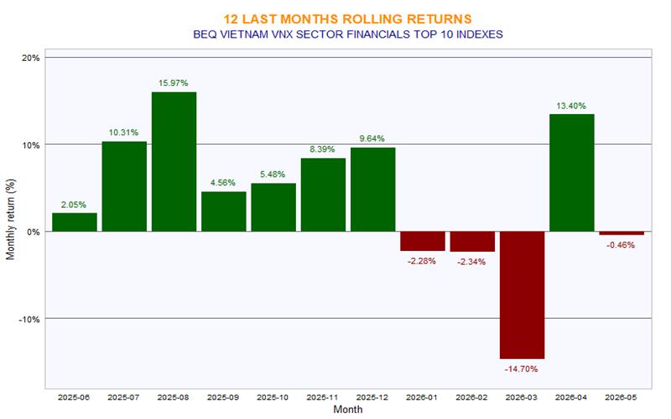
BeQ Vietnam VNX Financials Top 10 Index select the ‘best’ top 10 constituents of the BeQ Vietnam VNX Financials index in term of liquidity, and adjusted capitalization on free float. The index is weighted by the free float market capitalization, starting at 1,000 on the base date on December 31, 2008.
The Primary BeQ Vietnam VNX Financials Indexes are calculated in Price Return (PR) format, with Total Return (TR) and Net Return (NR) versions also available. The standard index currency is VND, while additional currency versions—such as AUD, CAD, CNY, EUR, GBP, HKD, JPY, KRW, SGD, USD, and USDC—are provided for overseas investors to reflect their actual performance.
Last Updated: May 31, 2026
Last Updated: May 31, 2026
Last Updated: May 31, 2026
Last Updated: May 31, 2026